
Create a landlord confirmation digitally
Statutory duty in Germany — fast, correct and built from your protocol data.
The landlord confirmation is often needed for registration at the local residents' office. With deep.rent it is generated from property, contact and handover data — instead of filling a blank form by hand each time.
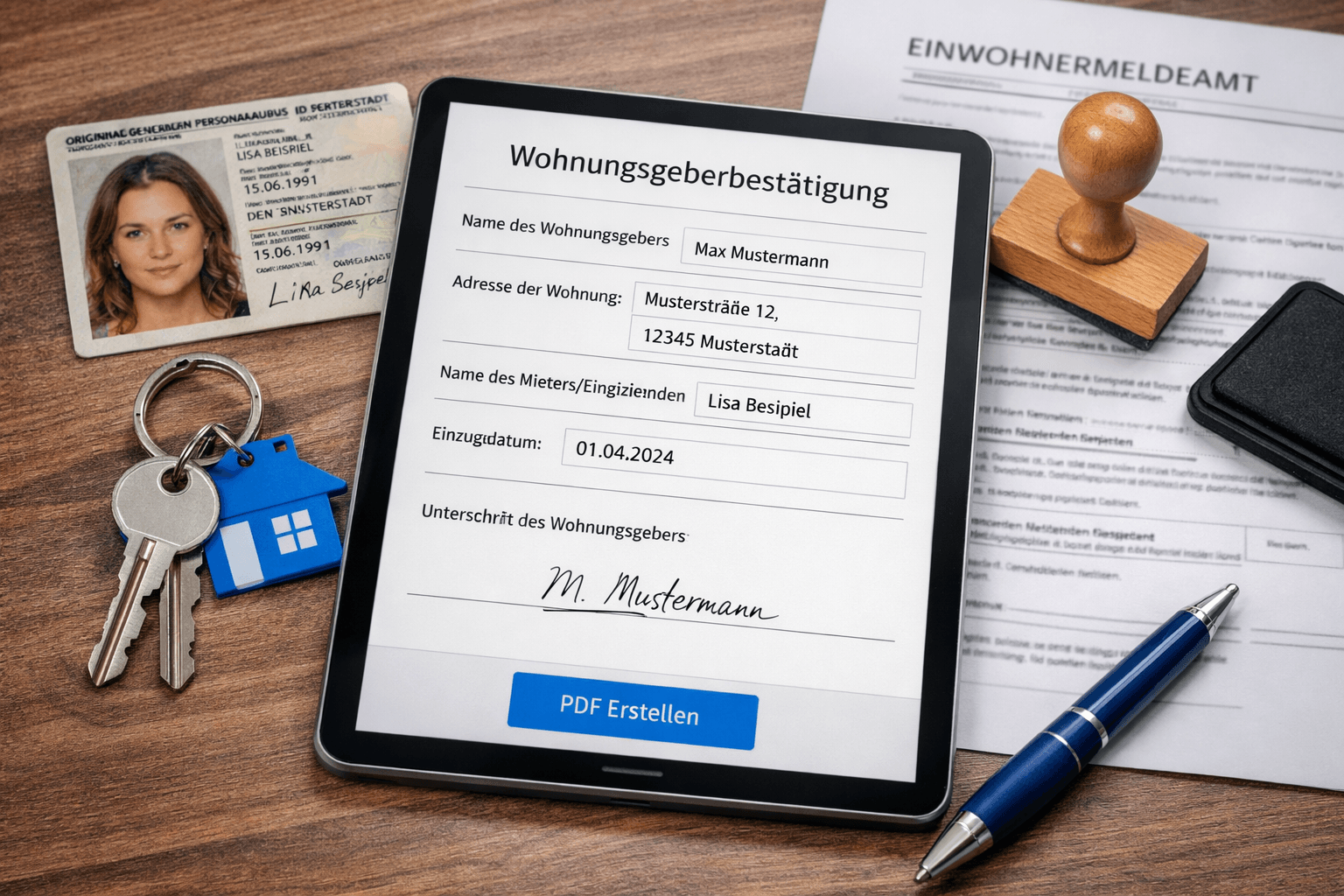
Create a landlord confirmation digitally digitally – on site and traceable
Guided capture with photos and videos per area – traceable for everyone involved.


Create a landlord confirmation digitally at a glance
Structured capture with photos, checklists and PDF – on site or via link.
-
Create a landlord confirmation digitally
Guided workflow with areas, media and signature.
-
Checklists & photos
Standardised items and image evidence per area.
-
PDF & archive
Automatic delivery and audit-ready storage.
What is the landlord confirmation?
In Germany the landlord (e.g. owner or authorised agent) confirms that the tenant is taking up the residence — registration with the authority usually requires this document. Colloquially people also say “landlord certificate” or “registration proof”; without it, registration often cannot proceed.
The landlord confirmation (in German law often Wohnungsgeberbestätigung, also confirmation by the landlord) is in Germany a certificate for the registration authority. The landlord confirms to the tenant and the office that they are taking up the residence — so the tenant can complete registration (change of address or first registration).
Why it matters
- Without the confirmation, registration at the residents’ office is usually not possible.
- The legal basis in Germany is the Federal Registration Act (BMG), in particular Section 19 BMG.
- It applies to every move-in to a new main residence — whether flat, house or room (details depend on the case).
With deep.rent you generate the confirmation from maintained property and contact data and the handover protocol — instead of filling a blank form by hand every time.
When is it needed?
Typically whenever someone moves in or changes their main residence and registers with the local residents’ office.
-
Move-in / new lease
First move-in or new main tenant — the confirmation is part of the registration package.
-
Relocation within Germany
Re-registration with a new address requires a new landlord confirmation.
-
After handover / protocol
Often after binding handover; dates should match the actual move-in.
-
Property management & representation
Managers or attorneys issue the confirmation on behalf of the owner.
-
Rooms or shared flats
Duty depends on the specific move-in; local practice may vary.
-
Registration deadline
Tenants usually must register within two weeks of move-in — timely issuance by the landlord supports compliance.
Legal background (Germany)
The duty to issue a landlord confirmation stems mainly from the Federal Registration Act (BMG). Details and forms can change — use official sources or legal advice if unsure.
Note: Not legal advice. Laws and authority forms can change; when in doubt use official sources or consult a lawyer.
- In Germany the landlord is legally obliged to issue a confirmation so the tenant can register (BMG).
- Content and format must meet the registration office’s requirements; local forms or online services may apply.
- Austria and Switzerland have their own residence rules — this page focuses on the German landlord confirmation.
- Digital creation with PDF does not replace the duty to provide correct information and make the confirmation available to the tenant.
What is usually in the confirmation?
Content and format vary by authority and form. Commonly included:
-
Tenant
Name and address of the person moving in.
-
Landlord
Name and address of the owner or issuing party.
-
Property address
Full address of the unit taken up.
-
Unit
Flat number, location or other identifiers if required.
-
Move-in date
Date of occupancy / effective move-in.
-
Confirmation & signature
Landlord confirmation, often dated and signed.
-
Reference to registration law
Legal reference may appear on official forms.
-
Further details
If required: e.g. marital status, previous address.
Workflow with deep.rent
From data maintenance to the document for the tenant:
-
Step 1 – Property & contacts
Address, unit and tenant or owner data live in the app.
-
Step 2 – Handover protocol
Document handover; relevant data is already linked.
-
Step 3 – Complete
After completing the protocol, the confirmation can be generated automatically.
-
Step 4 – Move-in date
Adjust the move-in date if needed before finalising the document.
-
Step 5 – PDF
Export as PDF for tenant, management or the file.
-
Step 6 – Send
Deliver to the tenant — e.g. by email — without a separate manual form.
Who is this for?
Everyone who handles move-ins and supports registration:
-
Landlords & private landlords
Issuing the confirmation to the tenant.
-
Property managers
Consistent documents across many units.
-
Agents
Support at handover and with tenant paperwork.
-
Tenants
Need the confirmation for registration.
-
Owners’ associations
Coordination via manager or representative.
-
Teams with several editors
Single source of truth instead of scattered files.
Manual & paper — typical issues
-
Wrong or outdated forms
Authorities and associations publish different templates.
-
Typos
Address, names or move-in date copied incorrectly.
-
Time spent
Every move-in means filling and signing again.
-
Media break
Protocol and confirmation no longer match.
-
Dispatch
Delays until the tenant receives the document.
Digital with deep.rent
Data from property, contacts and handover flow into the confirmation — fewer errors, less duplicate work.
-
Automatic generation
After protocol completion without a separate blank form.
-
Pre-filled fields
Tenant, landlord, address and unit from one system.
-
Adjustable move-in date
Align with actual occupancy without retyping everything.
-
PDF & archive
Store, retrieve and prove issuance.
-
Handover to tenant
Direct send or export — no extra paperwork loop.
Avoid common mistakes
These points delay registration or trigger authority queries:
-
Wrong move-in date
Differs strongly from actual occupancy.
-
Incomplete address
Property or unit not clearly described.
-
Missing or wrong signature
Not signed by the authorised landlord party.
-
Late issuance
Tenant cannot meet the two-week registration window.
-
Mismatch with lease
Names or address do not match the contract.
-
No copy on file
Later you cannot prove what was issued.
Module in the Protocol App
The landlord confirmation is part of the modules — together with handover protocol, properties and contacts.
-
Covers statutory requirements
Aligned with the practical duty under German registration law.
-
Tied to the protocol
Not detached from handover and registration paperwork.
-
Fast generation
Seconds instead of manual forms.
-
Consistent master data
One source for property, tenant and landlord.
-
Further modules
e.g. deposit settlement in the same ecosystem.
-
Scales for management
Recurring move-ins with consistent quality.
FAQ
Short answers on landlord confirmation, registration office and move-in — not legal advice.
Is the landlord confirmation mandatory?
In Germany the landlord must provide the tenant with a confirmation so they can register (see BMG). Details are set by law; use official information if unsure.
Is “registration certificate” the same as the landlord confirmation?
Search terms overlap — often people mean the landlord-issued document for registration. The actual registration certificate usually comes from the authority after registration.
Who is the “landlord” here?
Often the owner, landlord or authorised manager — depending on the setup. What matters is who is responsible towards tenant and authority.
How long does the tenant have to register?
In Germany tenants usually register within two weeks of move-in. Prompt issuance of the confirmation helps meet that deadline.
Is a PDF enough?
Many tenants submit a printout or a form accepted by the authority. Whether a digital signature suffices depends on the office — ask if in doubt.
What if the landlord refuses?
Tenants can contact the registration office or advice centres; legal help may be needed in disputes.
Must the move-in date match handover day exactly?
Not always; actual occupancy matters. In deep.rent you can adjust the move-in date before sending if occupancy is later.