
Create a deposit settlement digitally
Account for the rental deposit clearly — documented, traceable and auditable.
Whether you call it a deposit settlement, rental deposit statement or end-of-tenancy accounting: capture deductions, repairs and claims in a structured way and produce a clear statement for tenants, landlords or property managers.
Create a deposit settlement digitally digitally – on site and traceable
Guided capture with photos and videos per area – traceable for everyone involved.


Create a deposit settlement digitally at a glance
Structured capture with photos, checklists and PDF – on site or via link.
-
Create a deposit settlement digitally
Guided workflow with areas, media and signature.
-
Checklists & photos
Standardised items and image evidence per area.
-
PDF & archive
Automatic delivery and audit-ready storage.
What is a deposit settlement?
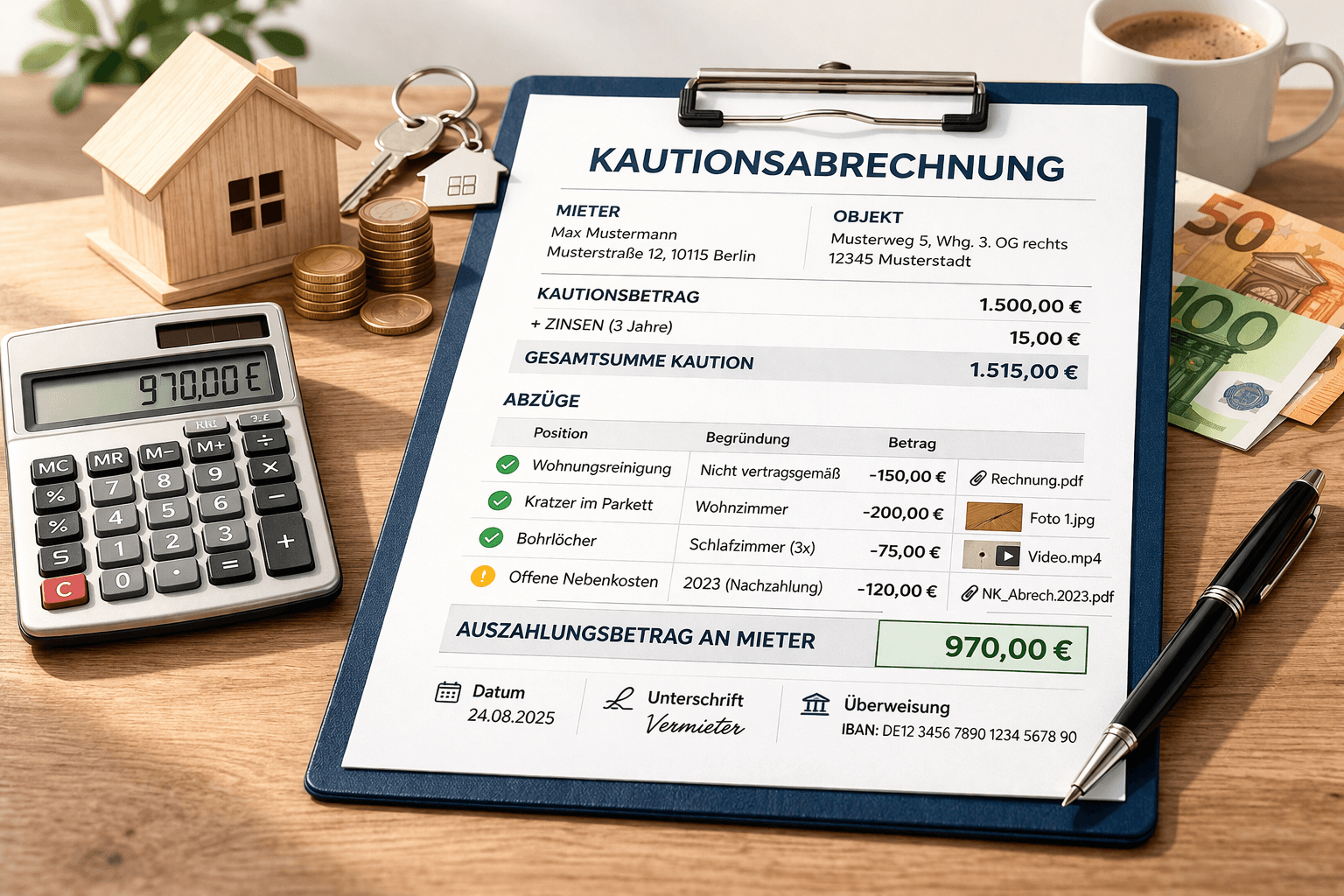
A deposit settlement (tenant deposit statement, rental deposit accounting or end-of-tenancy reconciliation) shows how the held security deposit is applied after the tenancy ends. Deductions, open claims, repair costs and the amount to be repaid are documented in a verifiable way.
A deposit settlement (also tenant deposit statement, rental deposit accounting or end-of-tenancy reconciliation) is the final offset of the security deposit when the tenancy ends or at an agreed time. It shows which amounts are retained from the deposit and what balance is repaid to the tenant — or whether a further claim remains.
Typical building blocks
- Original deposit and any partial payments already made
- Deductions with reasoning (e.g. repair, damage, contractually agreed items)
- References to protocols, invoices or cost estimates
- Balance and payout or claim amount
A clear template or structured process reduces disputes over deposit return, top-up demands and evidence questions — especially when move-out protocol and settlement align.
When do you need a deposit settlement?
A deposit settlement is usually prepared after the tenancy ends. Without a clear rental deposit statement, disputes often arise over deductions, damage or the repayment amount.
-
After move-out
After return of the unit, the security deposit is offset against damage, open claims or costs.
-
Damage or defects
Costs from move-out inspection, repairs or reinstatement can be charged against the deposit.
-
Service charges or additional claims
Open ancillary costs or contractual claims may form part of the settlement.
-
Partial repayment
Interim or partial payments should also be documented in writing.
-
Property management or owners
For managed properties, the statement must be traceable between manager, owner and tenant.
-
Legal protection
A documented deposit settlement matters in disputes, dunning or court proceedings.
Legal context for deposit settlements
Deposit accounting depends on the lease, statutory rules and case law. A clear, traceable settlement helps avoid disputes and support claims.
Note: General information only — not legal advice. Deposit rules, deadlines and deductions depend on the lease and national tenancy law (e.g. Germany, Austria, Switzerland) and the individual case.
- In Germany, statutory rules on return of the unit and the deposit are relevant (e.g. Civil Code); deductions usually need to be justified and traceable.
- A written statement with line items and receipts supports communication with the tenant and your records.
- Move-out protocols often underpin claims for decorative repairs or damage in the settlement.
- Digital PDF statements with timestamps and archive can improve traceability — content and evidence still decide the outcome.
What should a deposit settlement include?
A complete statement should list all positions so tenants and landlords can follow the final balance.
-
Tenant & property
Tenant name and address of the unit.
-
Deposit amount
Amount of the security deposit held.
-
Individual deductions
Repairs, damage, open claims or costs.
-
Evidence
Invoices, protocols or photos for each line item.
-
Balance
Remaining amount or claim after accounting.
-
Date
When the statement was produced.
-
Payout
Bank details or payment method.
-
Notes
Contractual basis or explanations where needed.
Typical workflow for a deposit settlement
How to structure rental deposit accounting after move-out:
-
Step 1 – Review protocols
Move-out or takeback findings form the basis.
-
Step 2 – Capture costs
Repairs, damage or claims are entered as separate line items.
-
Step 3 – Attach evidence
Invoices or photos are linked to each position.
-
Step 4 – Calculate balance
Deposit minus deductions yields the amount to pay out.
-
Step 5 – Create document
Generate a PDF or written deposit settlement.
-
Step 6 – Archive
Keep the statement and evidence for the long term.
Who benefits from a clear deposit settlement?
A traceable rental deposit statement matters for everyone involved.
-
Landlords
Correct accounting of the deposit after move-out.
-
Property managers
Consistent processes across many units.
-
Owners
Control over costs and repayment.
-
Tenants
Understandable deductions instead of blanket claims.
-
Finance teams
Documentation for tax and audit.
-
Legal cases
Evidence in deposit disputes.
Paper & Excel — typical weaknesses
-
Missing evidence
Deductions without invoice, protocol or proof often trigger disputes over the deposit.
-
Version chaos
Multiple Excel or Word files without a single source of truth make the settlement hard to follow.
-
Broken context
Move-out inspection, takeback protocol and deposit statement live in different places and no longer align.
-
Deadlines
Repayment or evidence deadlines are not documented, creating uncertainty.
-
Signature & dispatch
Manual steps, post and paper slow the process and increase errors.
Digital deposit settlement
Digital accounting gives you clear line items, complete evidence and traceable documentation.
-
Clear structure
Every item is captured and assigned unambiguously.
-
Traceable deductions
Each claim is backed by evidence.
-
Automatic calculation
Balance and remainder are calculated correctly.
-
PDF & archive
Export and store the settlement.
-
Team-ready
Suited to property managers with many units.
Common mistakes in deposit settlements
These issues often lead to disputes over the rental deposit.
-
Flat-rate deductions
Deductions without evidence are often not defensible.
-
No documentation
Missing protocols make accounting harder.
-
Unclear amounts
Tenants cannot follow the statement.
-
Deadlines ignored
Late settlement causes problems.
-
Missing invoices
Receipts are absent or unclear.
-
No archiving
The settlement cannot be proven later.
deep.rent: deposit settlement in the app
Link the settlement directly to protocols, defects and costs — from move-out to repayment.
-
Deposit settlement module
Record the deposit, calculate deductions and build a structured statement.
-
Pull in defects & costs
Costs from move-out, damage or repairs feed straight into the settlement.
-
Traceable accounting
Each line item links to protocol, photo or receipt.
-
PDF & sharing
Generate a PDF and share with tenant, owner or manager.
-
Archive & object link
The settlement stays tied to the property, tenancy and protocols.
-
Less duplicate work
No re-keying data in Excel, email or paper forms.
-
For landlords and managers
Scale consistent, verifiable settlements across many units.
FAQ: deposit settlement
Answers on rental deposit, settlement and repayment — not legal advice.
How long can the landlord hold the deposit?
After move-out the landlord may retain the deposit for a reasonable period to check damage, service charges or open claims. Exact timelines depend on the lease and situation. A clear settlement documents repayment correctly.
What may be deducted from the rental deposit?
Only justified, demonstrable claims are typically deductible — e.g. damage, repair costs or open ancillary charges. Flat deductions without evidence are often problematic. A structured statement with proof reduces conflict.
What should a deposit settlement look like?
It should state deposit amount, each deduction, evidence, balance and amount to pay out. The clearer the layout, the easier it is for both sides to verify.
Can I create a deposit settlement as PDF?
Yes, as long as all items, evidence and amounts are clearly shown. Digital documents are widely used when they are complete and traceable.
What if the tenant disputes the settlement?
Review protocols, invoices and documentation. A thorough move-out record and clean settlement support your position. Legal advice may help in disputes.
Can deposit, protocol and settlement live in one place?
With deep.rent you can connect move-out findings, defects, costs and deposit settlement in one system — end-to-end documentation from return of the unit to repayment.